


Where the Baltic Sets the Pace: Hotel Strand and the Quiet Art of Living on Bornholm
On a quiet stretch of Bornholm’s northern coast, where the Baltic Sea arrives in long, pewter-colored breaths and the light seems to rearrange time itself, Hotel Strand sits with a confidence that is both restrained and unmistakable. It is the kind of place that does not announce itself loudly. Instead, it waits—like the island it inhabits—for visitors willing to slow down enough to notice.
Bornholm, often called “the sunshine island” of Denmark, has long been an outlier: geographically closer to Sweden than Copenhagen, culturally shaped by fishing villages, granite quarries, and a stubborn independence from mainland trends. It is not a destination of spectacle. It is a destination of texture. Hotel Strand understands this instinctively.
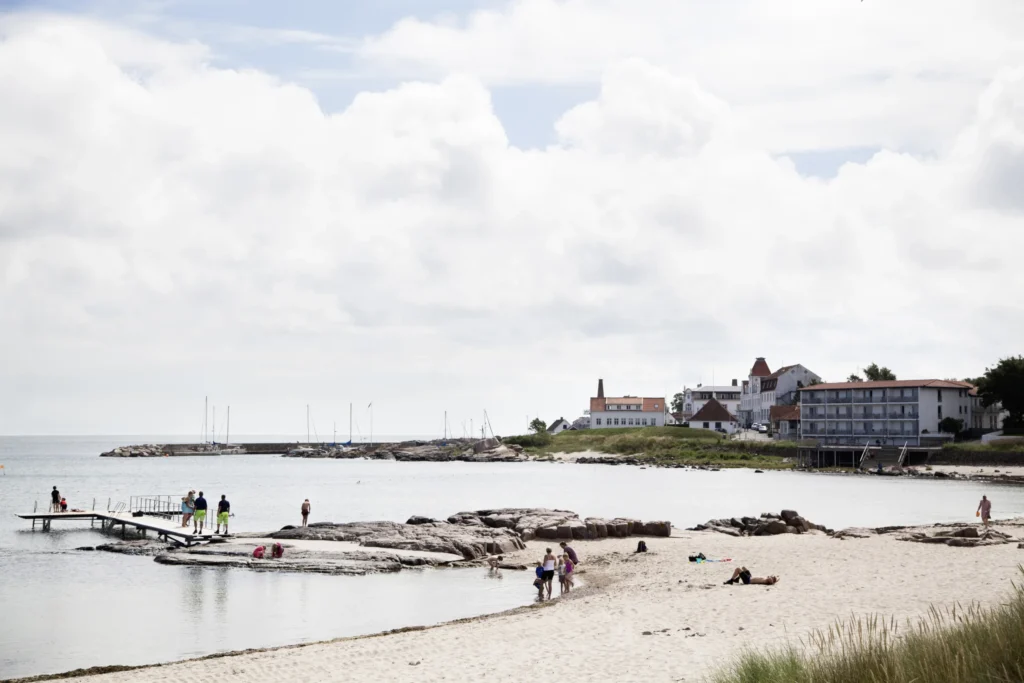
The hotel is located just outside Allinge, a small harbor town better known internationally for Folkemødet, Denmark’s annual democracy festival, which briefly turns the island into a buzzing political salon each summer. For the rest of the year, Allinge reverts to its natural state—quiet streets, working boats, and a coastline carved by wind and salt. Hotel Strand occupies a prized position here: directly on the water, with uninterrupted views across the Baltic, and only a short walk from town. The sea is not a backdrop; it is a constant presence, audible from every room, visible from nearly every angle.
The original building dates back to the early 20th century, when seaside hotels across Scandinavia were designed as restorative refuges—places where fresh air and measured routines were thought to cure modern malaise. Over the decades, Strand passed through several incarnations, some more successful than others, before being taken over by its current owners, a Danish family with deep ties to Bornholm and a clear-eyed vision for what the hotel could become.
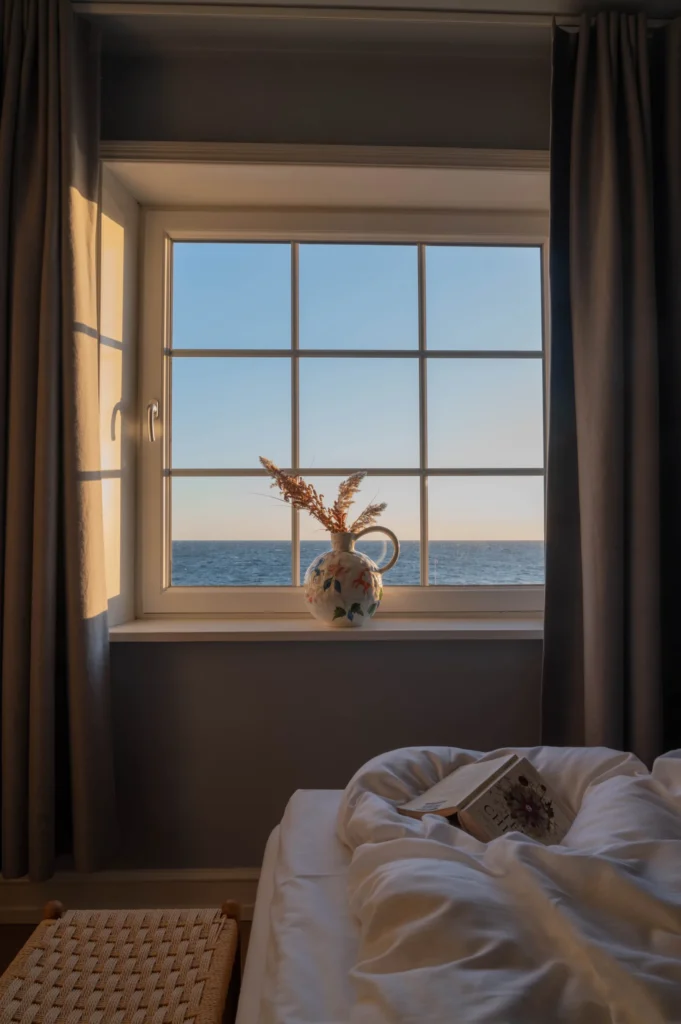
Rather than chasing international luxury trends, the owners made a deliberate choice to lean into locality. The renovation, completed in stages, was guided by Danish architects and designers who understood both the island’s history and its particular quality of light. The result is a hotel that feels contemporary without ever feeling imposed.
The exterior retains its classic seaside proportions—white façades, dark roofs, clean lines—while the interiors have been stripped back and rebuilt around natural materials. Pale oak floors, lime-washed walls, linen textiles, and custom-made furniture dominate the rooms. The palette mirrors the landscape: sand, stone, sky, and sea. Nothing shouts. Everything belongs.
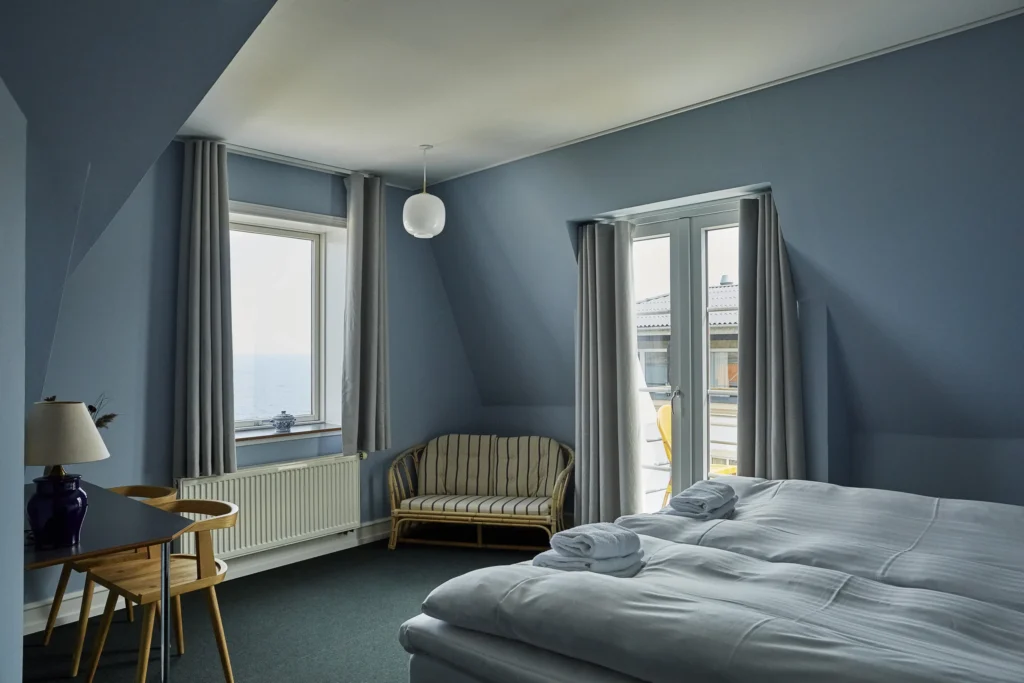
Many of the rooms feature private balconies or terraces facing the water, and it is not uncommon to see guests wrapped in blankets at dawn or dusk, watching the slow choreography of fishing boats or the sudden drama of Baltic storms. There are no televisions competing for attention. Instead, the sea performs.
Public spaces are designed to encourage a gentle kind of social life. The lobby flows into a lounge where large windows frame the horizon like a moving painting. A fireplace anchors the room in winter months, when Bornholm’s off-season reveals a different kind of beauty—bleaker, perhaps, but deeply compelling. Books on local history, art, and nature are scattered casually, signaling that this is a place where time is meant to stretch.
The restaurant, a central part of the Strand experience, is firmly rooted in Bornholm’s culinary revival. Over the past decade, the island has emerged as a quiet powerhouse of Nordic food culture, known for its smoked fish, artisanal dairy, organic farms, and foraged ingredients. Hotel Strand’s kitchen works closely with local producers, many of whom are neighbors in the truest sense.
Breakfast is an unhurried affair: dense rye bread, soft-boiled eggs, local cheeses, house-made jams, and smoked herring that tastes unmistakably of the island. Dinner menus change with the seasons and often with the weather. There is an emphasis on simplicity and clarity—ingredients allowed to speak for themselves, plated without fuss. In summer, meals spill out onto the terrace, where the low Nordic sun seems reluctant to set. In winter, candlelight takes over.

The owners are present without being intrusive. They are known to greet returning guests, to recommend walking routes along the cliffs, to point visitors toward small galleries, smokehouses, or swimming spots that do not appear in guidebooks. Their philosophy is less about hospitality as performance and more about hospitality as stewardship—of a building, a landscape, and a way of life that feels increasingly rare.
That sense of stewardship extends beyond aesthetics. Sustainability is woven quietly into the hotel’s operations: energy-efficient systems, waste reduction, partnerships with local suppliers that minimize transport. These choices are not marketed aggressively; they are treated as common sense on an island where resources have always been finite.
Hotel Strand attracts a particular kind of traveler. Many are Danish couples escaping Copenhagen for a long weekend. Others are Germans and Swedes drawn by Bornholm’s reputation for nature and food. Increasingly, international guests—architects, writers, designers—find their way here, often through word of mouth. What they share is an appetite for restraint, for places that reward attention rather than distraction.

In an era when hotels often strive to be destinations unto themselves, Hotel Strand takes a different approach. It acts as a lens through which Bornholm comes into focus. The island’s cliffs, beaches, and forests are not curated experiences; they are simply there, waiting. The hotel provides comfort, warmth, and a certain quiet elegance, then steps aside.
On a clear day, from the shoreline just below the hotel, it is possible to see all the way to Sweden. The view is a reminder of Bornholm’s liminal identity—Danish, yes, but also something else, something shaped by centuries of trade, travel, and isolation. Hotel Strand reflects that same duality: rooted and open, modest and assured.
It is not a place for rushing through. It is a place for staying long enough that the sea’s rhythms begin to feel familiar, that the light at different hours becomes a source of anticipation, that silence stops feeling empty and starts feeling generous. In that sense, Hotel Strand is not just a hotel. It is an argument—for slowness, for belonging, and for the enduring power of a well-chosen location, thoughtfully cared for.